Episode 12: The Cultivation of Dress Born from the Sea of Naples
Saturday, March 28th, 2026
Oliviero Morelli
MSC Cruises Japan, South-Korea, South East Asia
Cruises Division of MSC Group President
Instagram: @afamok
Instagram (His Winery):@lamolarawines

Neapolitan Heritage, Tokyo Influence
A gentleman shaped by Neapolitan dandyism, refined by Tokyo’s sensitivity to detail.He does not merely preserve tradition— he reinterprets it across cities.This is where Oliviero Morelli stands today.
There is a saying in Italy: “Vedi Napoli e poi muori” — See Naples and then die. Such is the overwhelming beauty of the city that one could see nothing greater afterward. That is Naples. Yet Naples is not merely a scenic destination. Through the Age of Exploration and into the Bourbon era, it flourished as a center of maritime trade and diplomacy — a gateway to the Mediterranean world. The sea was not simply a view; it was industry, negotiation, survival.
Our guest, Oliviero Morelli, MSC Cruises Japan, South-Korea, South East Asia Cruises Division of MSC Group President, was born and raised in that city. While he stands at the forefront of international business and is known to his many Instagram followers as a tastemaker of food and refined experiences, what interests me most is something quieter: his Neapolitan understanding of how clothing shapes life itself.
When one thinks of Italian fashion, Milan usually comes to mind. Indeed, Milan is the stage of collections. But the true sanctuary of tailoring is Naples. Just as London has Savile Row, Italy has Naples.
Neapolitan tailoring is a subject deserving its own exploration — and perhaps one day we shall devote an entire chapter to it. For now, let us look at a business leader who embodies its philosophy.
Culture in Naples Appears First in Appearance
The cultivation of Naples reveals itself not in theory, but in presentation. On the day of our interview, he wore a suit by a Neapolitan tailor. Soft construction. Shoulders that followed the natural line of the body. A silhouette that did not shout, yet was unmistakably present.
He said: “It’s not so much that I choose it because I like it. If you are born into a family in Naples, it is simply normal.” There was no affectation in this statement. It was inheritance.
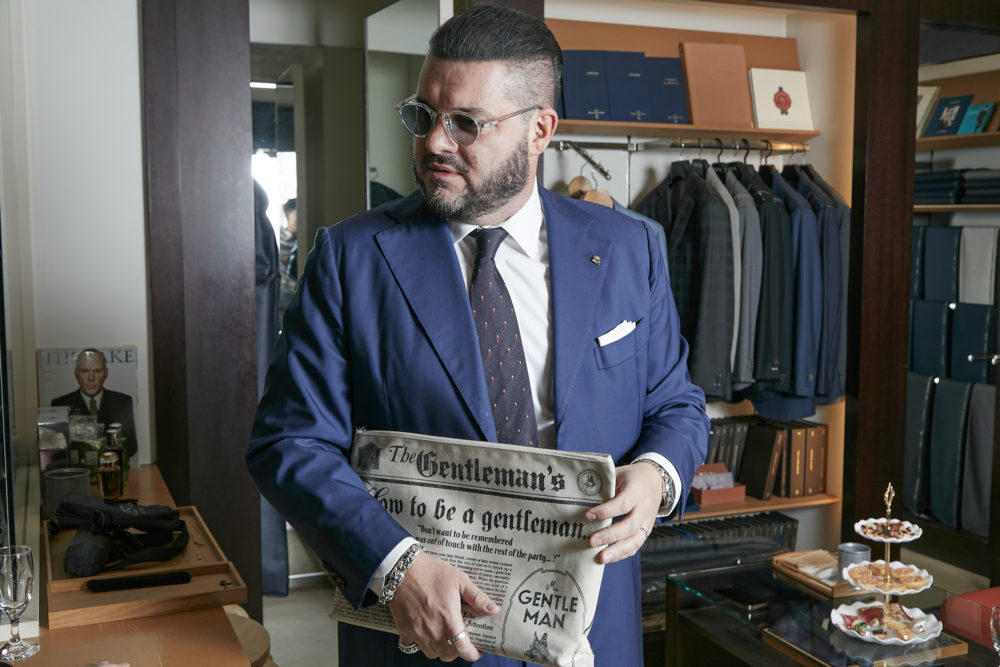
Wearing the cultivation of Naples
In a softly tailored Neapolitan suit and a knot inherited from his grandfather, he reminds us that true elegance is not display — it is continuity.
A Japanese Clutch, Ten Years in Britain
His styling that day carried traces of movement. In his hand was a clutch by the Japanese brand Mr. Gentleman, purchased a decade ago during his years living in the United Kingdom. “It looks very British,” he smiled. Made in Japan, yet carrying British air. A small object, yet emblematic of his life between cultures. His suit was by Solito, a Neapolitan tailor. “My grandfather wore suits. My father wore suits. It is simply how we grew up.” Shoulders, proportions, posture — these are not trends, but family language.
A First Suit at Eight — Tailoring as Family History
He recalls wearing his first suit at around eight years old, for his First Communion. In Naples, such garments mark rites of passage. They are not luxury. They are respect. He told me: “The most important thing about a suit is that it must be yours.” If one’s body changes, the suit must adapt. If it is too tight, it restricts not only movement but thought. A suit, for him, is not armor. It is a second skin.
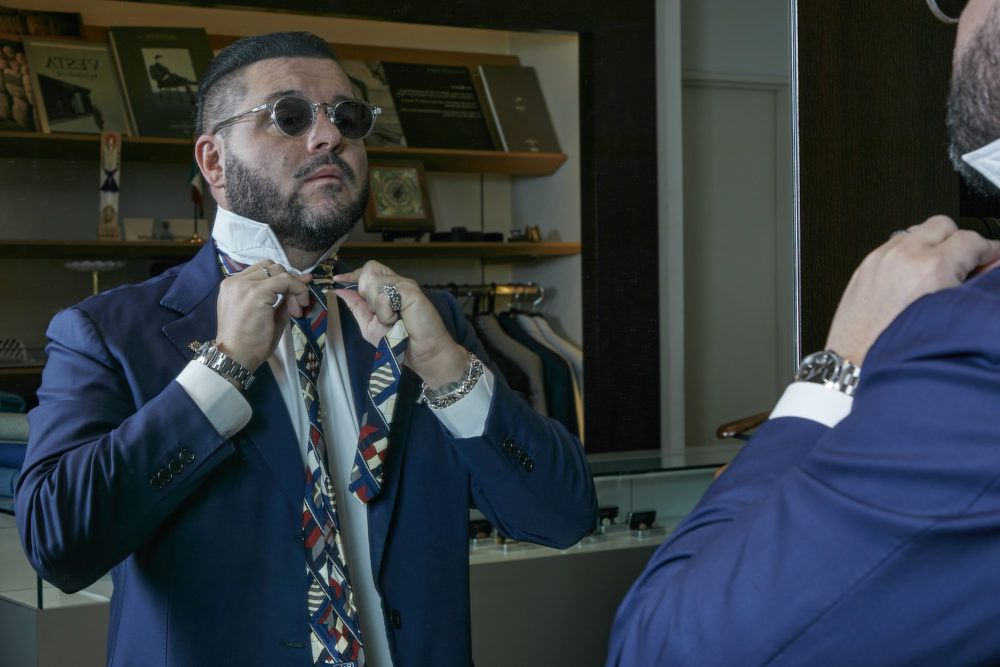
Inheritance in the Knot
A Ralph Lauren tie inherited from his grandfather. And the knot taught by that same hand. Classic dress lives on — carried vividly from one generation to the next.
Even the way he ties his tie reflects inheritance. He knows only one knot — the one his grandfather taught him. “If you ask me to tie another knot, I cannot,” he laughs. In Naples, a slightly fuller knot is preferred. He ties a double knot, not as a stylistic decision but as a continuation of hand memory — the same motion passed down through generations.
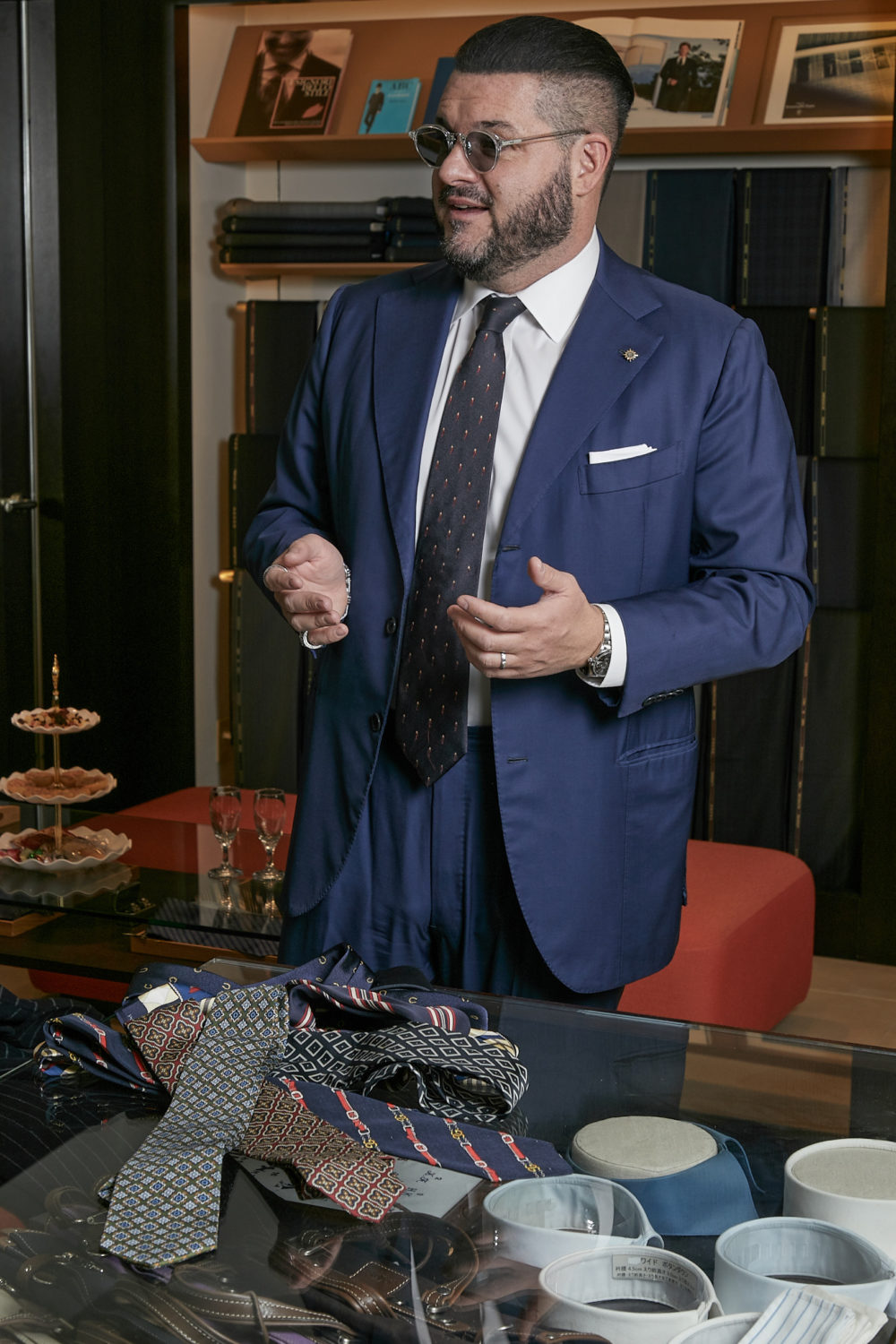
Ties of Inheritance
On the day of the interview, Oliviero arrived carrying a selection of ties inherited from his father and grandfather. Laid carefully before us, they were more than silk and pattern — they were fragments of Neapolitan heritage, a quiet testimony to the sartorial culture passed down from one generation of men to the next.
In Naples, Everyone Has Their Tailor
“Every Neapolitan has his own tailor,” he states without hesitation. Among friends, conversations inevitably turn to comparison: “My tailor is the best.” “Yours has good shoulders, but mine has a better lapel roll.” It is not rivalry. It is affection. A tailor sees your body change over time. “Ah, you gained a little.” “You lost weight — are you well?” “A tailor is like a doctor,” he says. In Naples, everyone has a family tailor.
“Copy the Most Important Person” — A Father’s Lesson
His philosophy of dress is rooted in a lesson from his father. “If you are at an elegant dinner and don’t know which fork to use, look at the most important person at the table. Copy him.” At worst, you make the same mistake as the most important person. No one will blame you. This is not merely table etiquette. It is a way of reading hierarchy, of understanding structure. The same applies to removing one’s tie.
Removing the Tie — A Gesture of Intimacy
Japan has its own protocols, such as Cool Biz. He respects them. Yet in a business dinner that progresses from formal meeting to secondary gathering, the temperature of the room shifts. “If the boss removes his tie, it means we are no longer speaking as business figures, but as friends.” So he removes his tie as well. When subordinates ask him when it is appropriate in Japan to loosen formality, he answers simply: “Look at the most important person.” Dress is not first self-expression. It is language of respect.
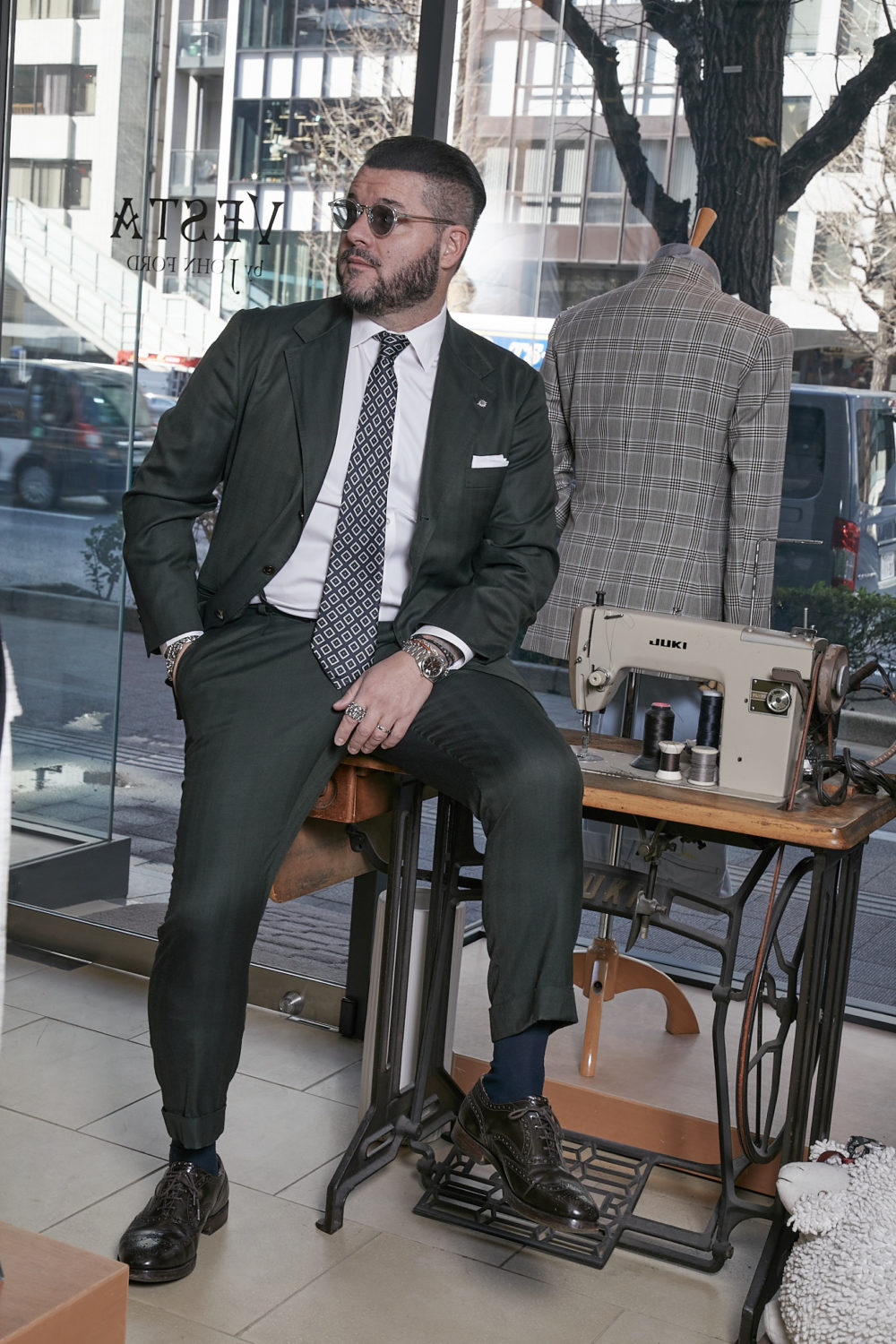
Even Moss Green, Worn with Dandy Ease
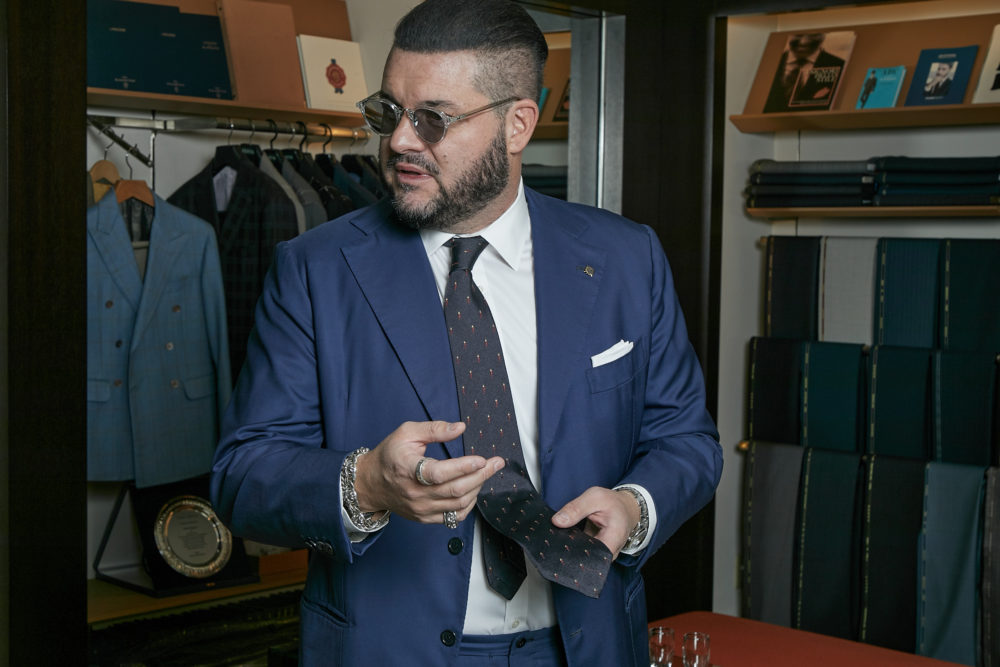
The moss-green suit, a seasonal shade, was tailored by his friend at COPPIA. The tie is a vintage Marinella. Over the sartorial foundations shaped in Naples, he layers the accessories he came to embrace in Japan.
A Tie That Must Remain Untouched
The Marinella tie he has worn for many years will not be repaired. The cornetto is something that must never be fixed. Even when his friend Alessandro Marinella offers to restore it, Oliviero refuses. In the name of the Neapolitan cornetto tradition, he says, this is something no hand may alter.
Corno — Fortune Only Works When Given
His tie carries a small red coral horn — the Neapolitan Corno (or Cornetto). He explained its ritual with animated Neapolitan gestures. Traditionally carved from coral, the small horn must be rubbed beneath the fingernail — between nail and skin — to “make it yours.” There is a belief that by touching that sensitive place, where the body feels most immediate, one integrates the charm into one’s own cells. Fortune is not decoration. It must be internalized. There are two rules. First: you must never buy it yourself. It must be given to you. Second: if it breaks, you must not repair it. If it breaks, it means the horn has absorbed a misfortune meant for you. To repair it would deny its sacrifice. You must receive a new one as a gift. His Marinella tie has worn with time; the horn slightly frayed. His friend Alessandro Marinella — fourth-generation president of E. Marinella — has often offered to repair it. But he refuses. “You must not repair it. That is the tradition.” This is not superstition. It is continuity.
A Jacket Tailored for a Memory
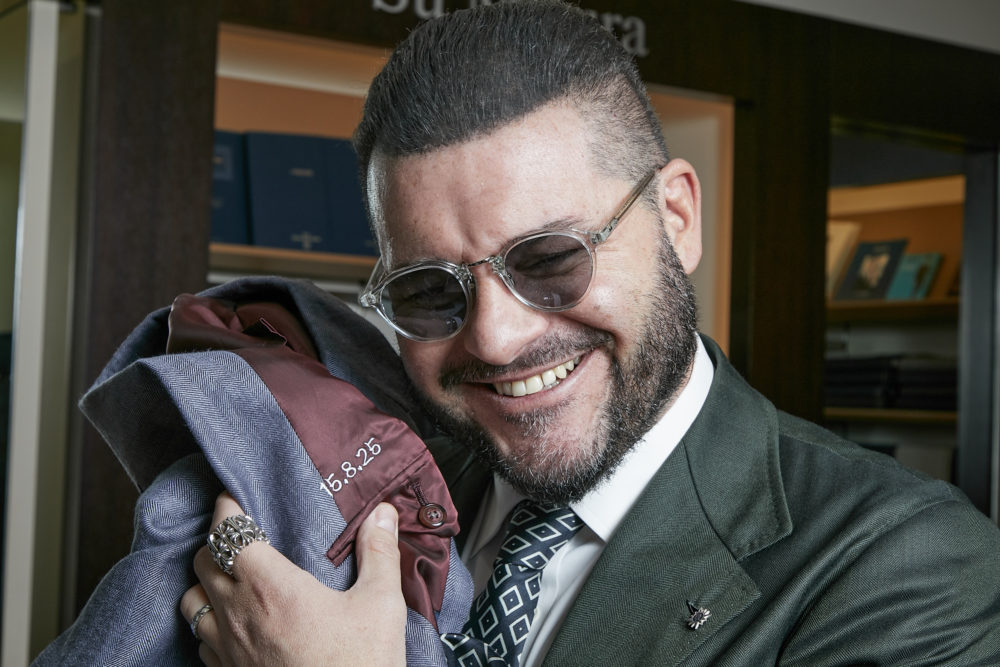
A jacket tailored at Wisdom Tool. Inside the lining, the date of his wedding day is embroidered. Clothing is not merely something we wear—it is a vessel that preserves the moments of a life.
Marinella — Three Generations of Friendship
The tie, naturally, is by E. Marinella, Naples’ most storied tie house. His grandfather’s shop stood beside the Marinella boutique. Each morning at six, both would open their doors. “Buongiorno” became friendship. The second generation continued the bond with Maurizio Marinella. Today it lives on between Oliviero and Alessandro Marinella. (Alessandro Marinella also appeared in my column, Good Clothing Can Change Life, Episode 4)
There is more. His father produces a rare wine in Avellino, near Naples. For Marinella’s 110th anniversary celebration, this wine was served under a special commemorative label — each bottle adorned uniquely, an idea of Alessandro himself. That same wine can now be found in select restaurants in Japan. A tie and a bottle of wine. Both require time. Both require trust.
MSC Cruise and the Ritual of Gala Night
MSC is globally recognized for cargo shipping, and through its cruise division he oversees Japan and Korea. Next year marks twenty years with the company. When speaking of life onboard, his voice brightened. MSC hosts “Gala Night.” Some companies call it “Formal Night,” but he prefers “Gala” — less rigid, more celebratory. Guests dress elegantly. The atmosphere transforms. Lobster, filet, wine — the ship itself shifts mood. “I personally think Gala Night in Italy and Japan is the most enjoyable,” he says with a playful smile. Dress changes energy. It changes space.

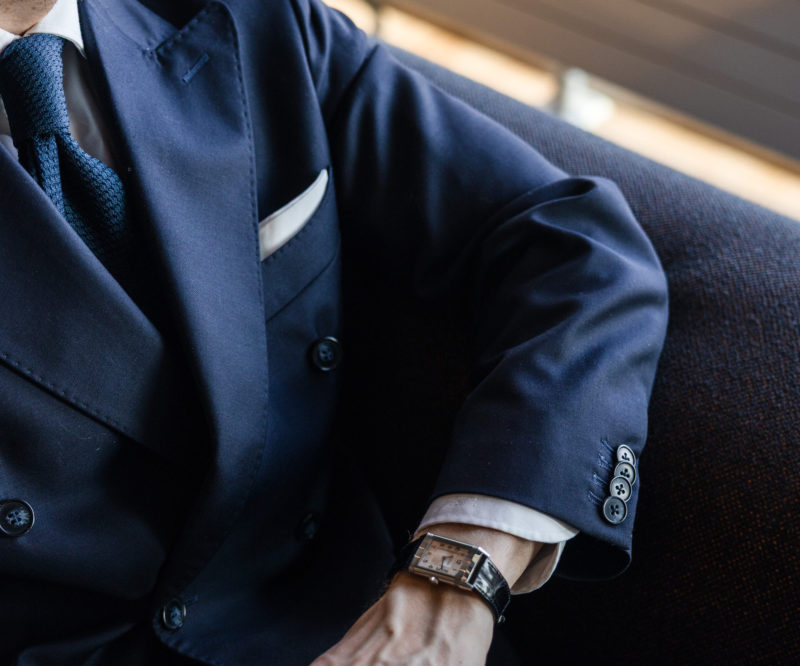
Sartoria Solito Navy and the Art of Sprezzatura
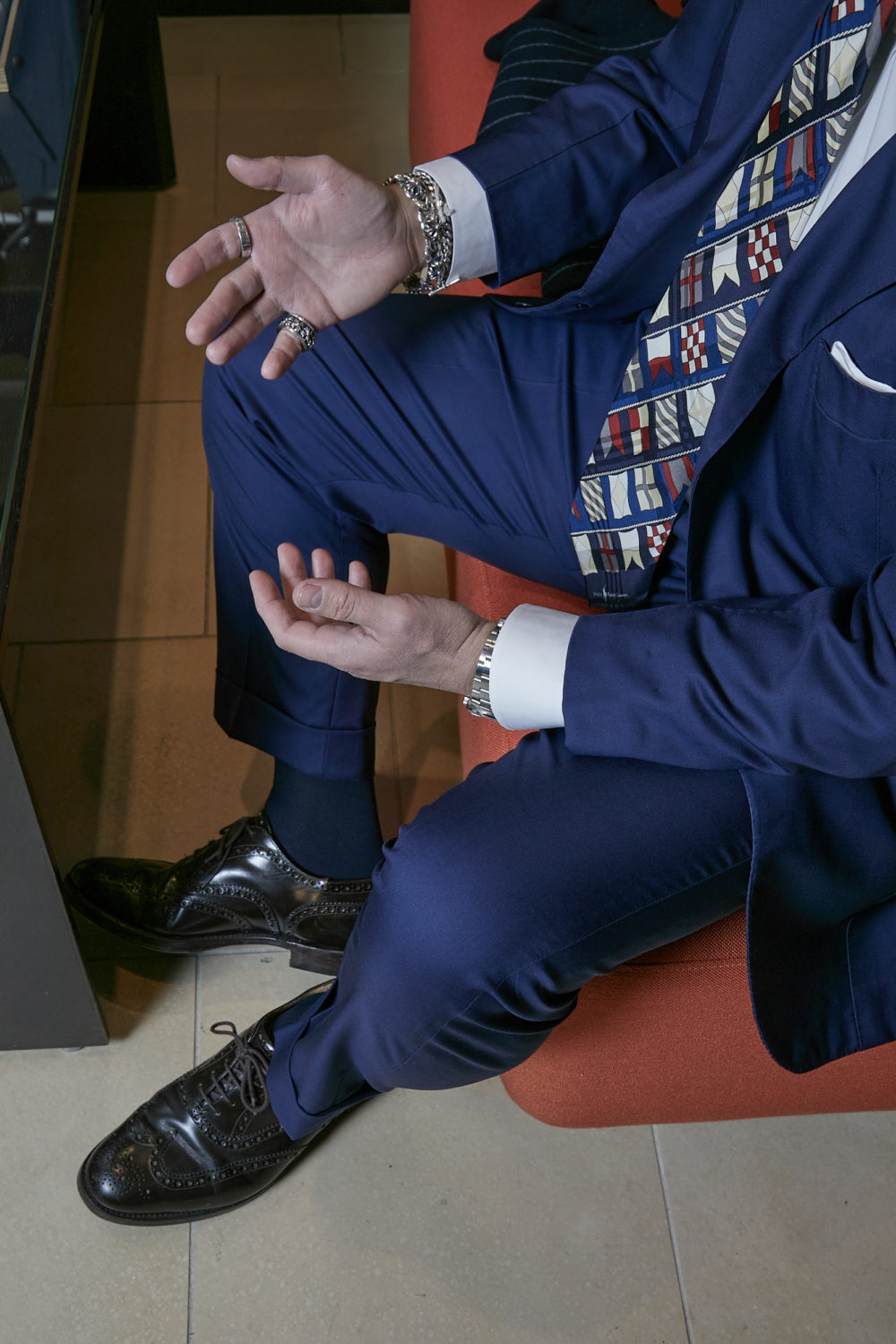
The well-worn navy suit is crafted by the Neapolitan house Sartoria Solito. An essential color for any Neapolitan man, worn here with ease. In Oliviero’s posture, one sees how the Neapolitan manica camicia shoulder gives life to true sprezzatura.
What Japan Changed — Sensitivity to Detail
“Has your style changed since coming to Japan?” I ask. “Of course.” He once wore only a watch. In Japan, he learned the power of detail — rings, bracelets, subtle accents. Yet he adjusts depending on whom he meets. With governors, mayors, officials, he removes visible accessories, keeping only what is discreet. Dress is situational intelligence.
Cutting the Shoe — Bespoke as Adaptation
In Japan, shoes must be removed frequently. He refuses to wear larger shoes simply for ease. “Big shoes are ugly,” he says plainly. Instead, even with his Church’s shoes, he modifies structure — adjusting heel and side — so they slip on and off more easily. He does not change size. He changes structure. That, he says, is bespoke.
Even the Finest Shoes, Made Personal
Even a pair from a storied house is not beyond refinement. He discreetly adds a cut, customizing them to suit Japan’s culture of removing shoes. The silhouette remains; the function adapts. That, to him, is bespoke.
Good Clothing Can Change Life
Oliviero Morelli’s attire carries the history of Naples’ port, the ritual of First Communion, his grandfather’s tie, his father’s lesson, and a three-generation friendship. In Japan, it gained refinement — a heightened awareness of detail and of respect in context. Good clothing can change life. Not by making you appear important. But by helping you understand where you stand, whom you face, and what distance to maintain. The cultivation born from the sea of Naples still breathes quietly inside his suit.
Photography: Leslie Kee


Author: Miyuki Kitagawa
General Manager of VESTA by John Ford, a bespoke tailor in Ginza, Tokyo. Native in Japanese, fluent in English, Italian, and French, she has 25 years of experience as a menswear expert. Known for her exceptional eye for quality fabrics and craftsmanship, she serves a clientele that includes top executives, politicians, and ambassadors worldwide. Even former Italian ambassadors to Japan have praised her work. She frequently contributes to fashion publications and has a deep knowledge of sartorial history. Her favorite food is fugu sashimi (tessa). https://johnford.co.jp/