Episode 10: When Choosing Good Clothing Becomes a Way of Life — A Tailored Life Guided by Sustainability
Saturday, January 17th, 2026
Featuring: Johan Wikström (The Sartorial Finn)
Sartorial Influencer
Instagram: @sartorial_finn
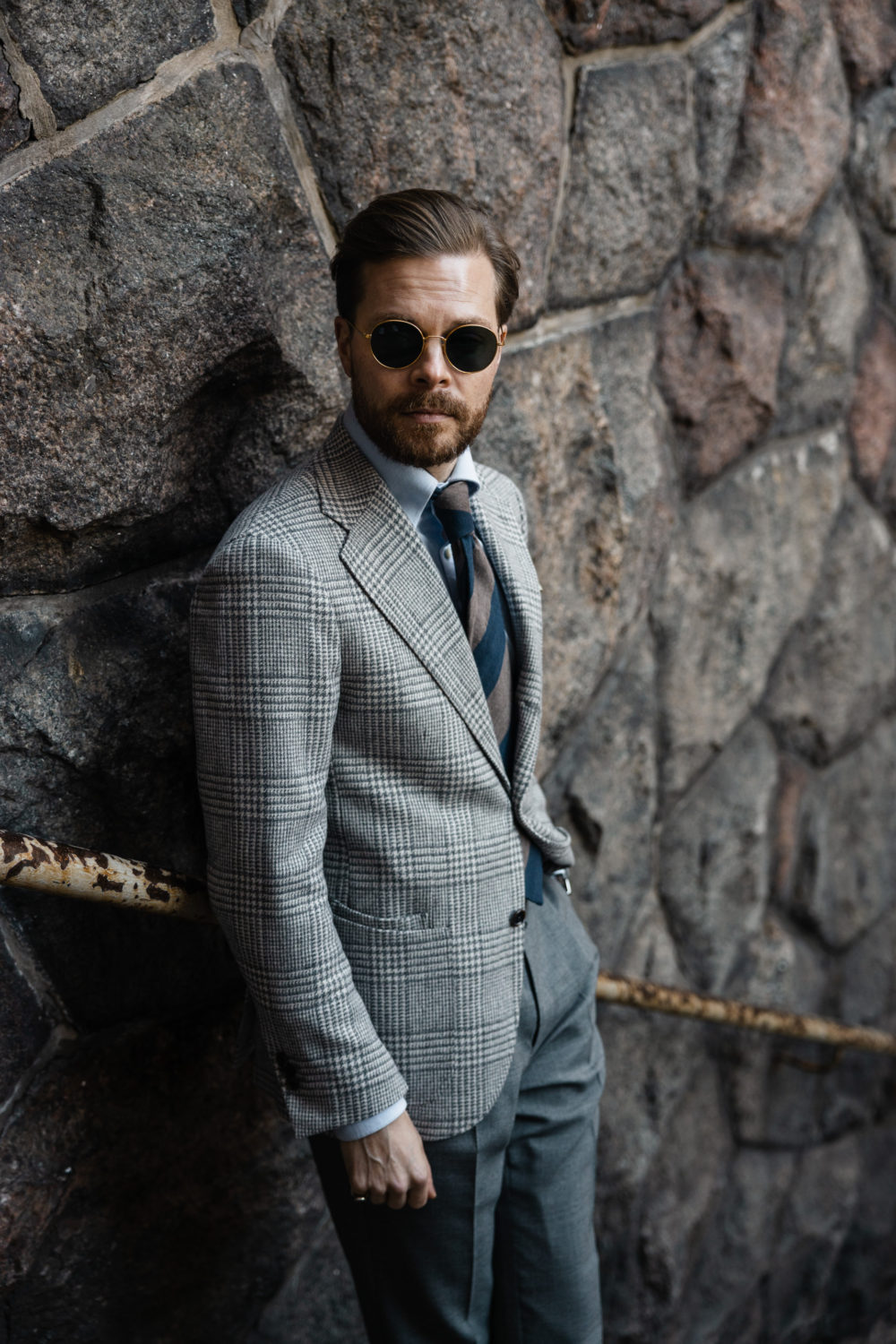
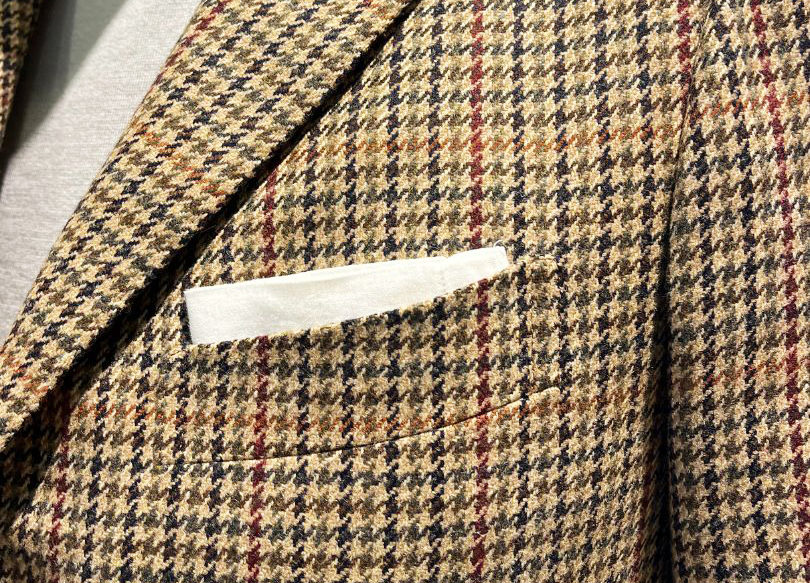
A large-scale Glen check is softened through a gentle palette, keeping the look calm and understated. The balance of pairing the check with a bold regimental tie is equally striking.
In Finland, complimenting someone’s outfit is not common. People notice. They appreciate—but most keep their thoughts unspoken. In a country that, like Japan, values restraint, one man has quietly brought tailoring back into everyday life, subtly changing the mood of those around him. Johan Wikström is a business leader with a background in IT consulting. Today, he heads a data and analytics division at a local company, managing an organisation of more than one hundred people. At the same time, he is known globally as The Sartorial Finn, followed by classic menswear enthusiasts around the world on Instagram. What makes Johan compelling is not a simple story of “wearing suits against the tide of casualisation.” Rather, it is the question of why he chose this path, how that decision is intertwined with his life today, and how—both as a professional and as a father—he continues to evolve his style in a way that fits reality. In his story lies the very essence of what this series seeks to convey: good clothing can truly change life.
How Fatherhood Changed the Way He Dresses
Johan is the father of a two-year-old boy. Recently, he took approximately four months of parental leave, devoting himself fully to childcare. They travelled, spent time at their summer house, and shared moments he describes as deeply fulfilling. In Japan, four months of paternity leave may still feel unusually long. In Finland, however, it is simply a natural option. This reality of fatherhood has shaped Johan’s approach to clothing in a very tangible way. He still wears tailored jackets frequently, but he now wears full suits and ties less often than before. The reason is simple: life with a small child is unpredictable. There is always the risk of stains, damage, or sudden mishaps. As a result, he has shifted toward durable fabrics, practical materials, and separates rather than full suits. This is not about giving up elegance. It is about refining elegance so that it functions within real life.
The Moment He Discovered Tailoring
Johan’s deep interest in classic menswear began six or seven years ago, shortly before COVID. At the time, he was working at a law firm—one of the few environments where suits were still relatively common. That was when he first thought, quite simply, “Suits are cool.” But there was another, more decisive factor: sustainability. Even before his fascination with tailoring, Johan loved fashion. Yet he grew tired of constantly chasing trends—new collections twice a year, endless replacement, perpetual consumption. He wanted to step away from that cycle and choose something timeless, something made to last. That desire led him to the world of made-to-measure.
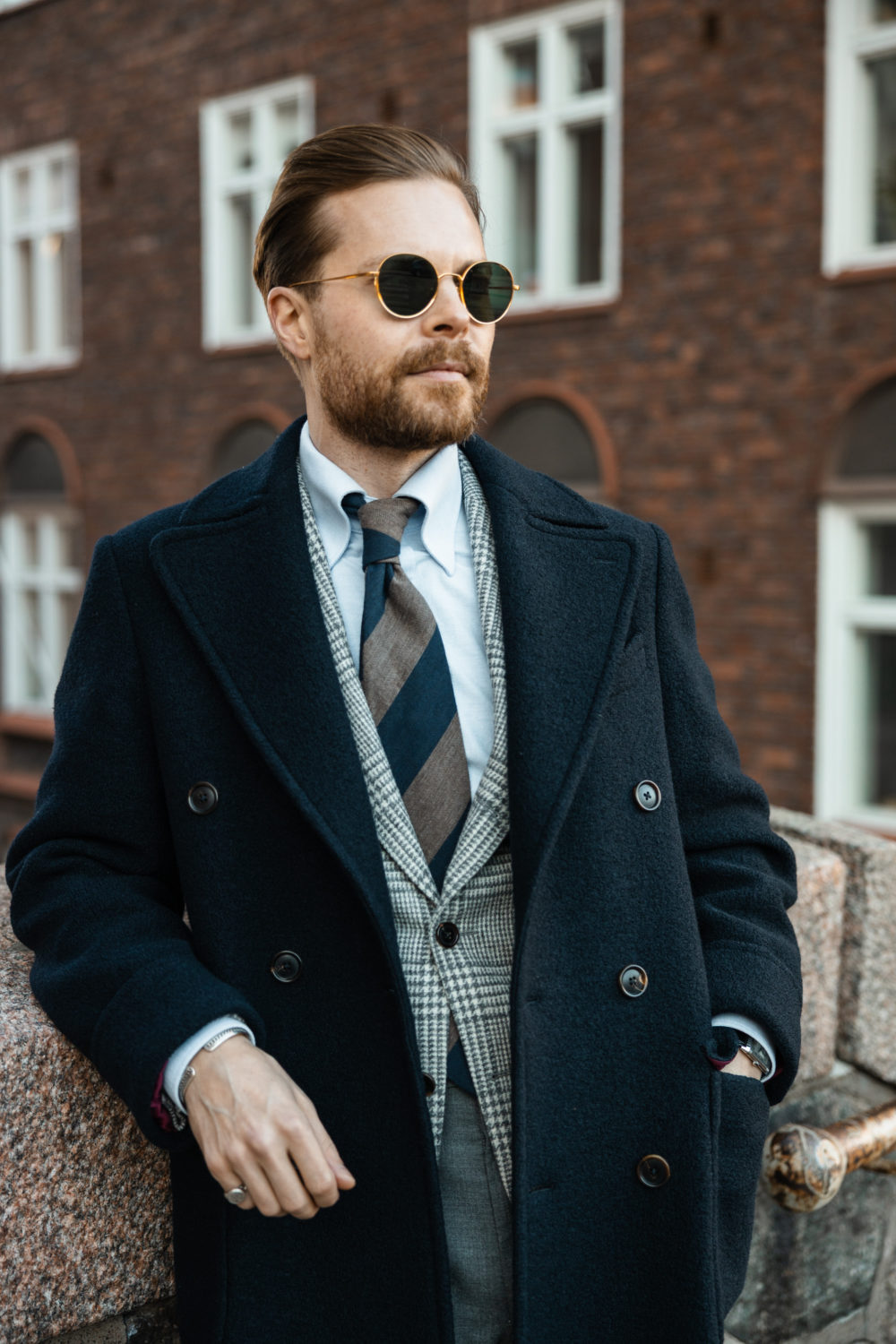
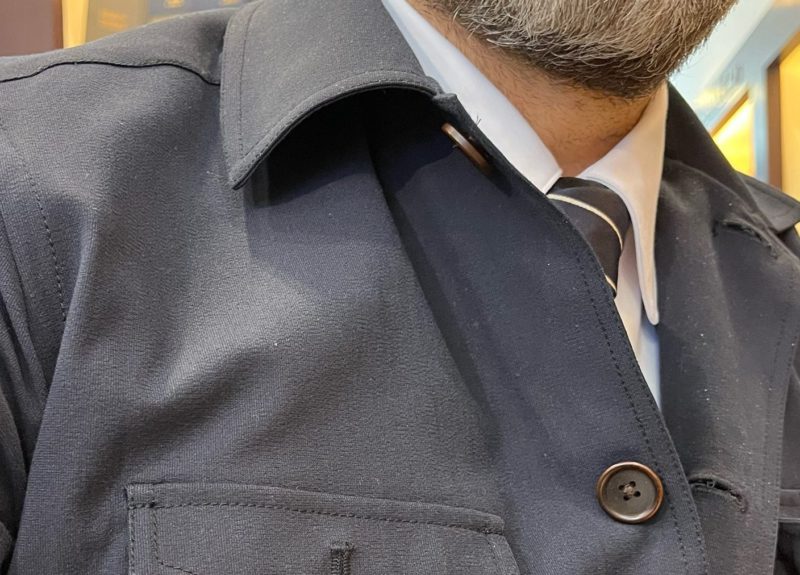
In downtown Helsinki, near the historic Temppeliaukio Church, the navy of the coat and tie is carefully coordinated to create a quiet sense of cohesion. The sunglasses add definition, sharpening the softness of the look against the city’s understated urban backdrop.
A First Failure That Became the Beginning of Learning
His first made-to-measure experience came through a tailor introduced by a senior colleague at the law firm. The result, however, left him dissatisfied—not because the tailor lacked skill, but because Johan himself lacked the language to express what he wanted. In tailoring, there is a shared vocabulary: lapel shapes, shoulder construction, ease, trouser break. Johan simply didn’t yet know how to speak it. And this is where his character truly shows. Instead of giving up, he began to study obsessively. He researched online, learned terminology, trained his eye, and tried again with another tailor. The results improved. He tried once more. Eventually, he laughed and admitted he had become “addicted.”
Rebuilding a Wardrobe from Zero
Johan did not gradually add pieces to his wardrobe—he rebuilt it entirely. He sold or gave away his old clothes and started over. In the first year alone, he invested around €20,000–€25,000. It may sound extravagant, but for him it was not waste. It was education. An investment in understanding. Seven years later, only one suit and one or two shirts from that first year remain. His taste continued to evolve—subtly, precisely. To the untrained eye, his style may look consistent from the beginning. But those familiar with tailoring immediately notice differences in fit, structure, and softness.
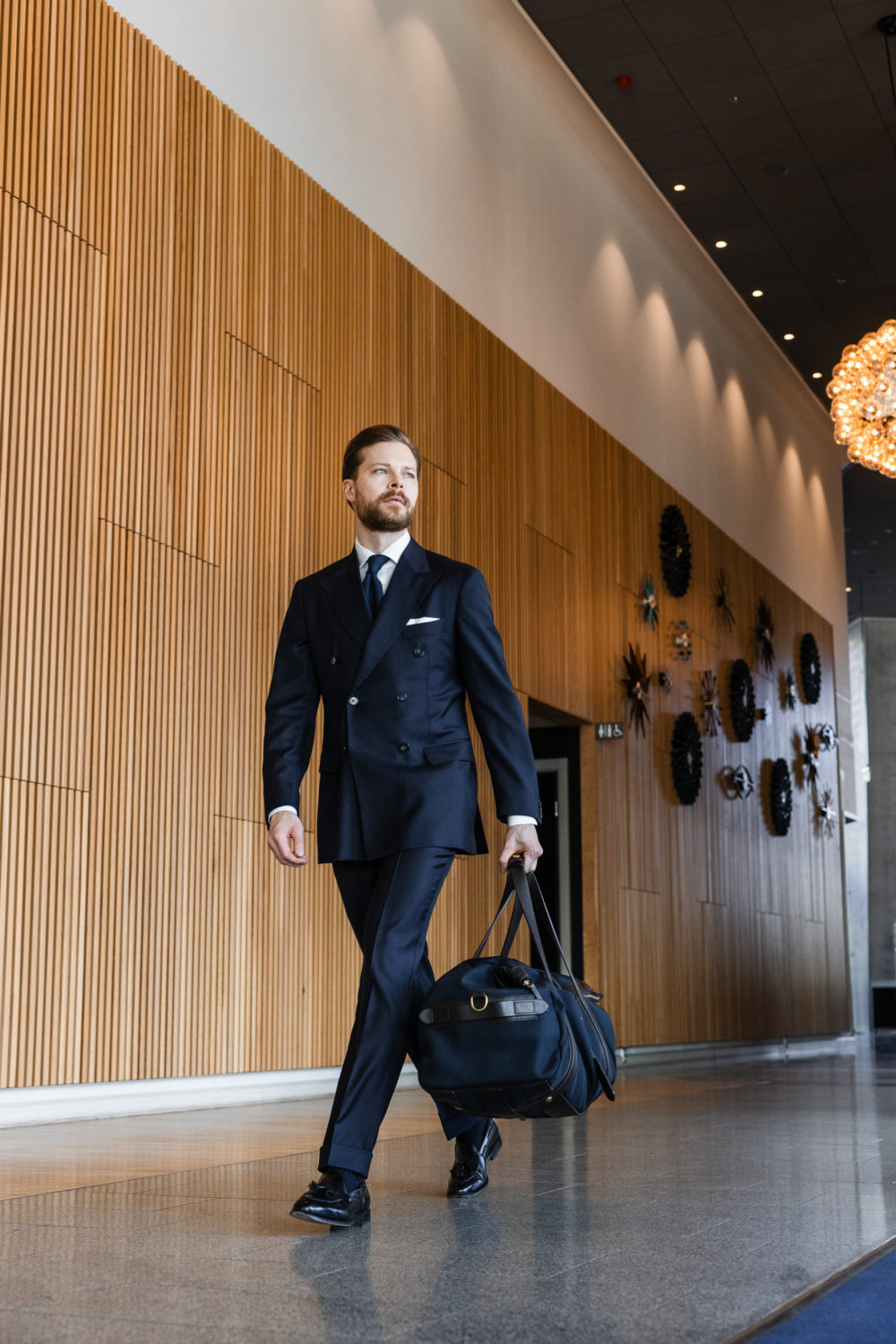
“I have a deep fondness for double-breasted suits. As they return to prominence, a DB in navy feels subtly more formal—and allows you to stand apart from the sea of single-breasted suits.” Commissioned as an alternative to a classic single-breasted navy, this suit is Johan’s choice for semi-formal occasions. Photographed at Clarion Hotel Helsinki, in Jätkäsaari.
Precision, Not Extremes
Tailoring trends shift: slim to relaxed, short to long, structured to soft. Johan, however, avoids extremes. He stays close to the middle, allowing his style to fluctuate gently around a personal axis. What has changed most is his preference for softness. Earlier on, he leaned toward more structured jackets. Today, he is drawn to softer, more Italian-influenced tailoring—relaxed, casual-leaning, yet unmistakably refined. This evolution is not trend-driven. It is life-driven.
From a Private Account to a Global Audience
Johan never intended to become an influencer. At first, Instagram was simply a place to collect inspiration. Eventually, his feed became so saturated with menswear that his friends’ posts disappeared. To separate the two, he created a private account—purely for personal reference. He began with headless mirror selfies, recording what he liked and disliked. It was a visual diary he didn’t share with friends or even his wife. Then a friend recognised the apartment in the background. By that point, he already had 15,000 followers. From there, the account grew organically. Photography had long been his hobby, and when menswear and photography intersected, The Sartorial Finn was born. Today, his largest audience is in the United States, followed by Europe and Asia—including Japan, Vietnam, and Taiwan. The distribution is global and remarkably balanced.
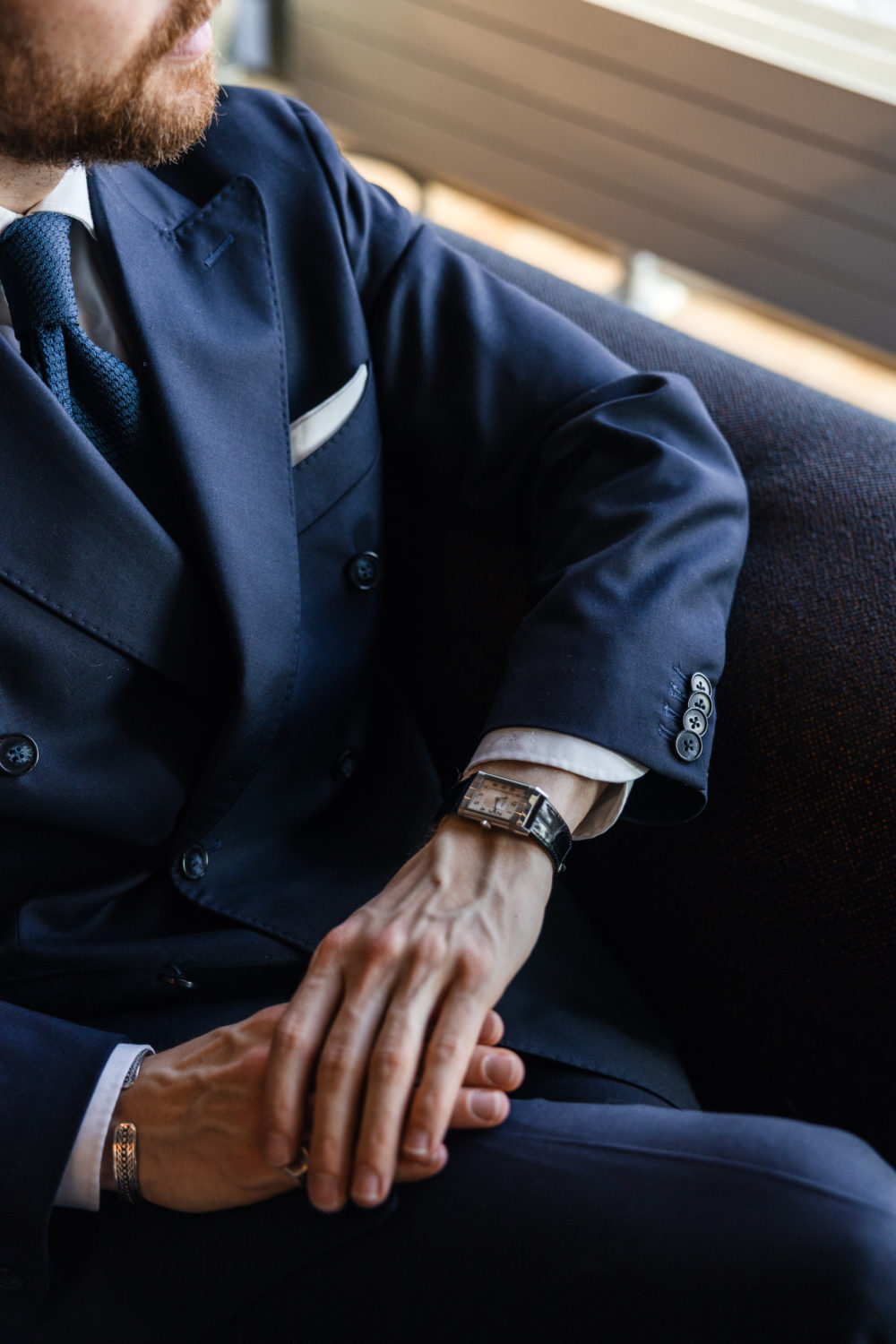
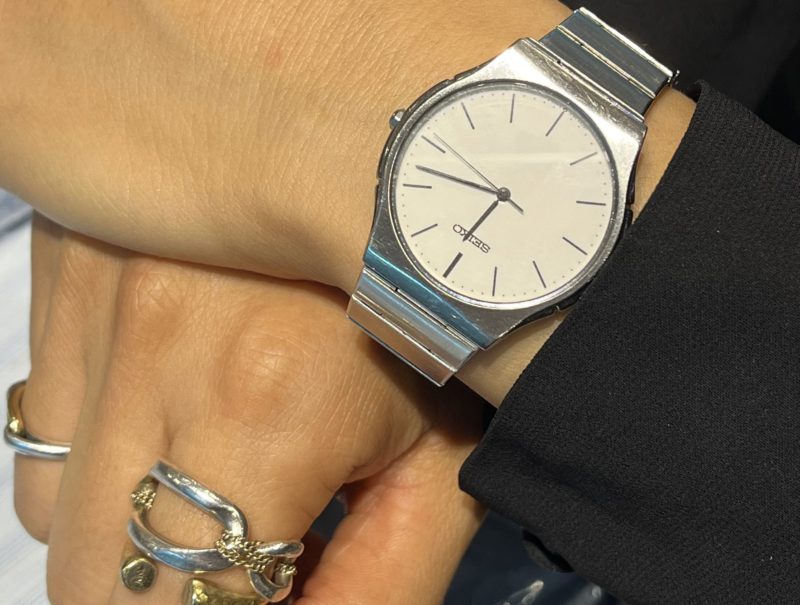
Following his father’s advice—“At least own one proper suit”—he interprets it for today in a double-breasted jacket cut from a lustrous navy blue fabric. The contrast between a Reverso at the wrist and a silver bangle speaks to his modern sensibility, embodying a contemporary approach to classic suiting.
A Grandfather’s Bespoke Suits, a Father’s Advice
When I asked where his sense of elegance originated, Johan spoke of his grandfather. His grandfather, rare for Finland, wore bespoke suits throughout his life. Only later did Johan see photographs of him as a young man—immaculately dressed, often in double-breasted suits, maintaining his style until the very end. As a child, Johan didn’t fully understand why, but he deeply respected him. From his father came a simpler message: “At the very least, you should own one proper suit.” That advice stayed with him.
Ultra-Casual Finland—and Standing Out Quietly
Workplace dress in Finland has long been casual, even before COVID. In today’s IT industry, remote work is common, offices are sparsely populated, and clothing is informal: T-shirts, sweaters, jeans. Even chinos are rare. Jackets are rarer still. In such an environment, Johan naturally stands out when wearing a tailored jacket, dress shirt, or occasionally a tie. He admits it is noticeable. Yet he has never received negative reactions—only positive ones. He once worried people might see it as costume-like, but that fear proved unnecessary. When clothing feels natural and worn with confidence, people simply perceive it as appropriate. Interestingly, his style has influenced his friends—not by turning them into suit wearers, but by subtly raising awareness. Better shirts appear. Shoes improve. Interest grows. That is real influence.
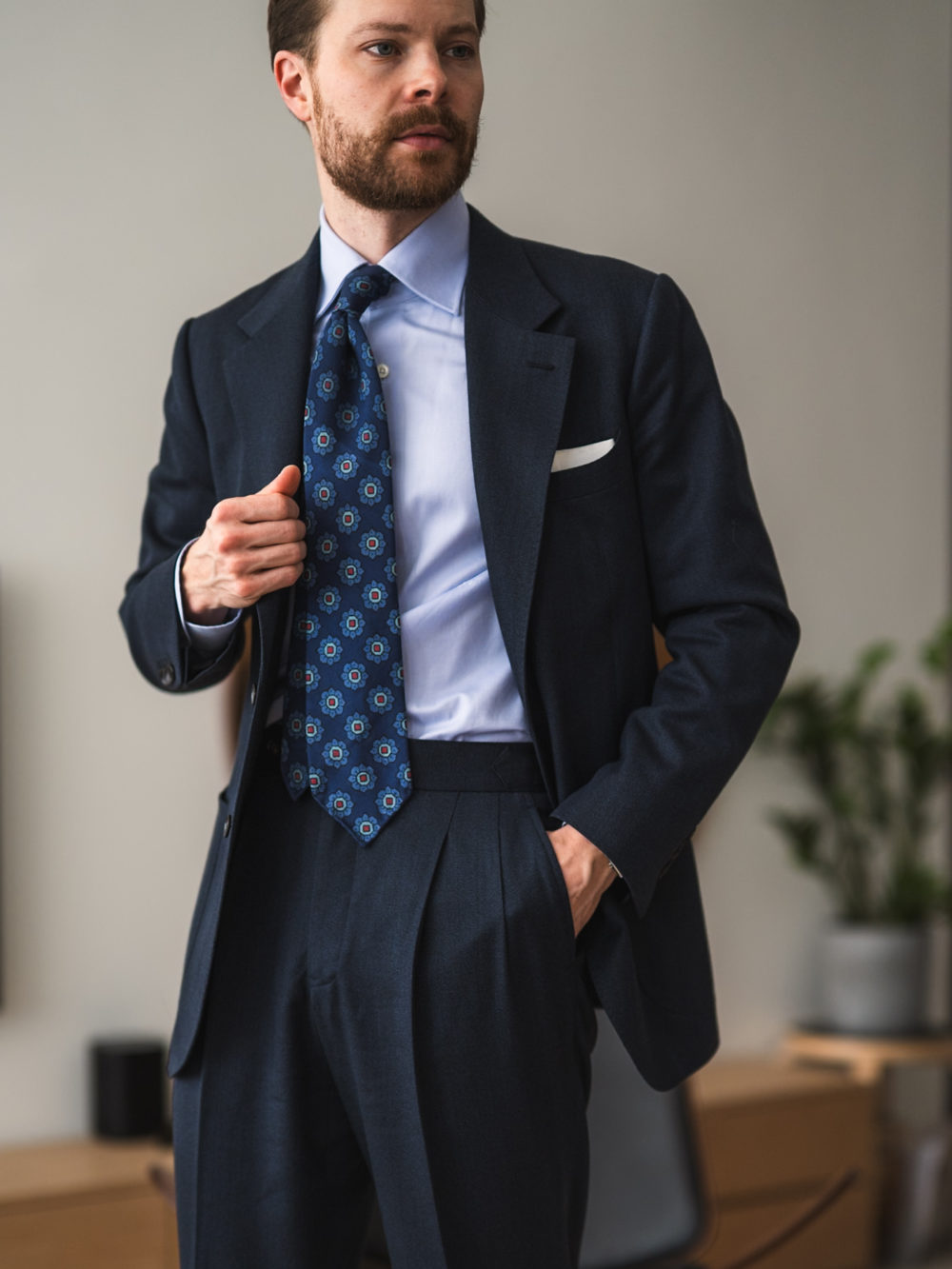
Double-pleated, beltless trousers—once a symbol of tailoring tradition, now revived with renewed relevance. It is here that classic and modern converge, revealing the true pleasure of tailored fashion. Tie by Stefano Cau.
Coming-of-Age Rituals and Formal Dress
Finland also has a unique relationship with formalwear. Around age fifteen, young people participate in Konfirmaatio, a Christian rite of passage where wearing a suit is customary. At seventeen, there is a high-school dance—traditionally requiring white tie. Today, fewer young people own white tie, and many opt for suits instead. Johan, however, inherited his father’s white-tie ensemble and had it altered by a tailor. To inherit, adjust, and wear a garment at a life milestone—few stories embody good clothing can change life more clearly.
What Clothing Gives Beyond Appearance
Does dressing well bring tangible advantages? Johan recalls one moment in Hong Kong: his friends were refused entry to a bar, while he was allowed in—simply because he was properly dressed. But the deeper benefit is internal. “When I wear clothes that look good on me, I feel comfortable. Confident. More productive.” Clothing shifts mindset, sharpens focus, and subtly improves how one operates in the world.
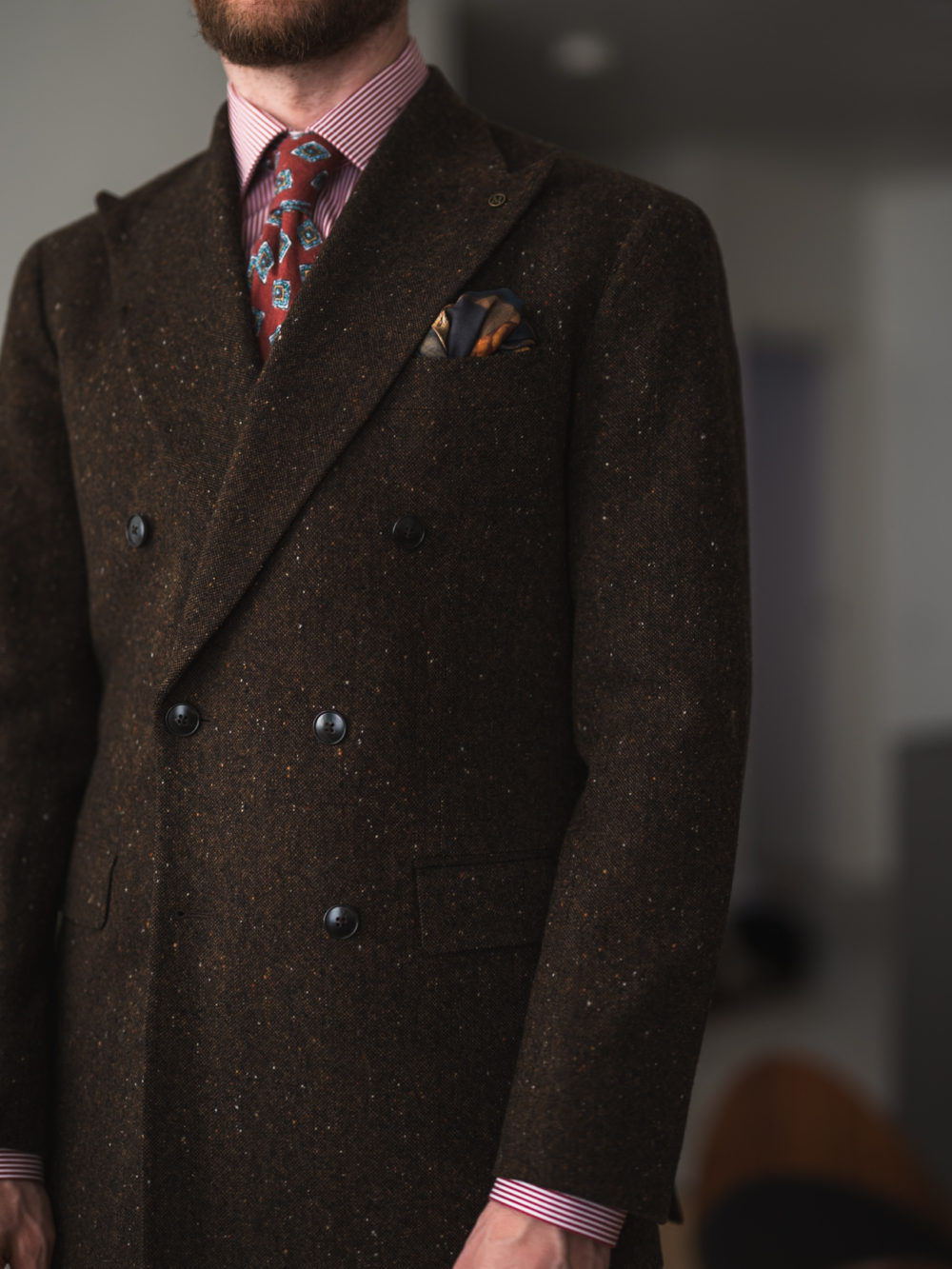
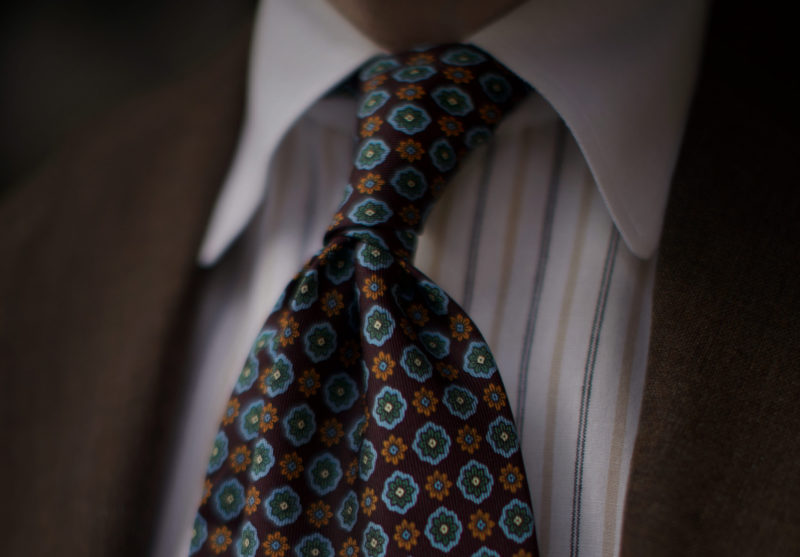
A brown double-breasted suit paired with a red micro-stripe shirt. The rounded puff fold of the pocket square softens the look, lending a sense of ease to the overall composition. What Johan finds most appealing in this styling is its tonal balance. While the suit reads as brown, the fabric carries subtle red undertones. By layering it with a red striped shirt and a red tie, the look becomes quietly tonal—an approach rarely seen with red, a colour often considered too bold. Here, however, red is woven into the ensemble with restraint, resulting in an understated yet expressive harmony.
The Shape of Clothing That Supports Life
Johan’s story is not about glorifying old-fashioned formality. It is about living in a casual society, working in IT, raising a family—and still shaping tailoring to fit real life. Good clothing is not meant to impress others. It exists so that you can be yourself. And as life changes, it should change with you—softly, intelligently, and sustainably. That is what Johan taught me. And that is why GOOD CLOTHING CAN CHANGE LIFE.
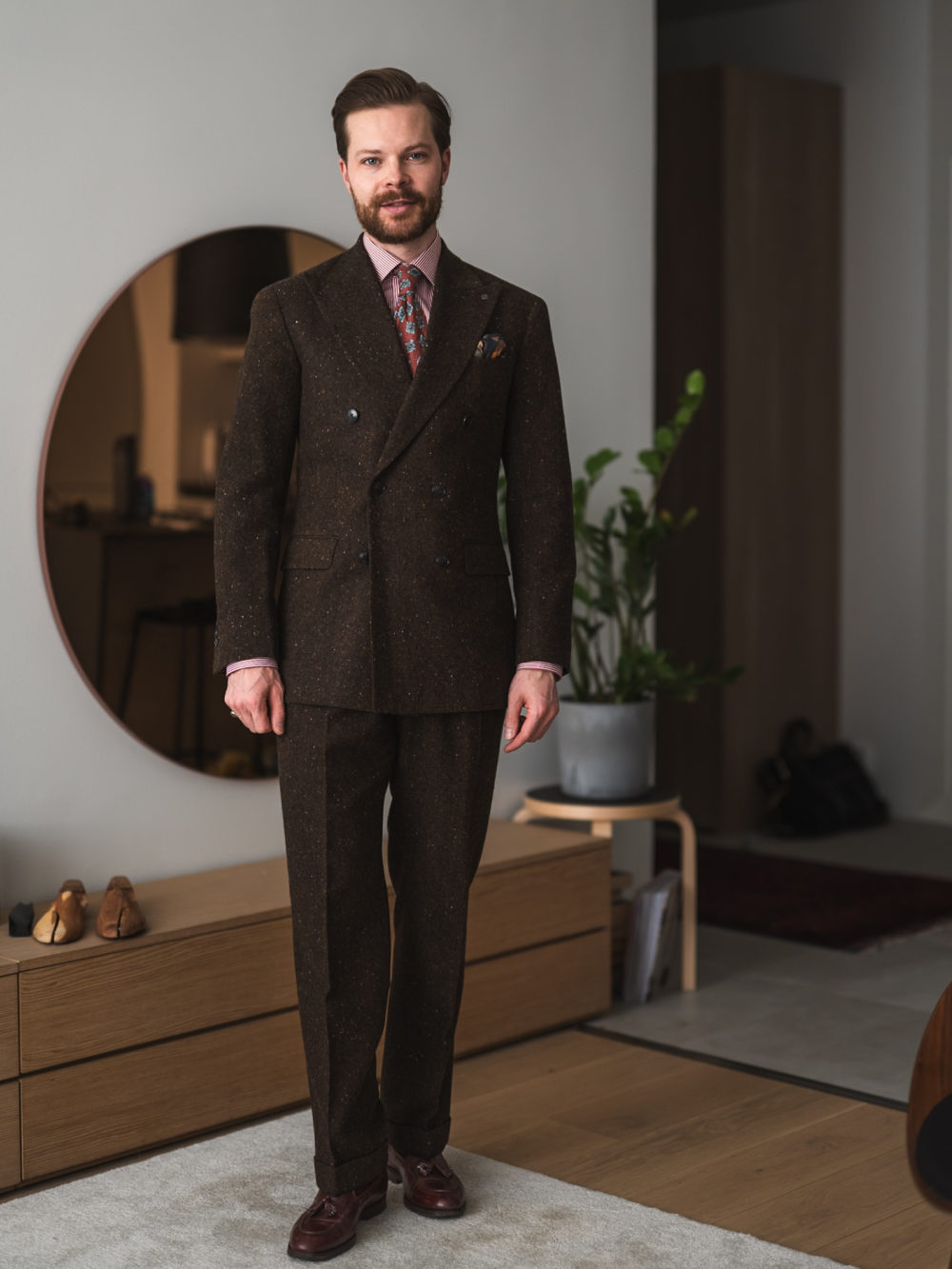
This photograph was taken in Johan’s former home in Helsinki—the space where a friend first discovered his presence on Instagram as The Sartorial Finn (he has since moved). Drawn to the quiet, minimalist interiors characteristic of Finland and the Nordic region, Johan finds a shared sensibility there. “There is an aesthetic in the Scandinavians,” he says, “that feels remarkably close to the philosophy of Japanese Zen.”
Photography: courtesy of Johan Wikström (The Sartorial Finn)
🎥 Watch the behind-the-scenes short from this interview on YouTube.


Author: Miyuki Kitagawa
General Manager of VESTA by John Ford, a bespoke tailor in Ginza, Tokyo. Native in Japanese, fluent in English, Italian, and French, she has 25 years of experience as a menswear expert. Known for her exceptional eye for quality fabrics and craftsmanship, she serves a clientele that includes top executives, politicians, and ambassadors worldwide. Even former Italian ambassadors to Japan have praised her work. She frequently contributes to fashion publications and has a deep knowledge of sartorial history. Her favorite food is fugu sashimi (tessa). https://johnford.co.jp/